Magazine “Praxis” · Reading time approx. 6 min
Christmas, Easter, milestone birthdays: When two families of origin make claims, the couple becomes the place where it all gets negotiated. How the genogram of both families takes the pressure out of the fight over “Who celebrates where?”
The Calendar as a Loyalty Test
In many counseling centers, a familiar season begins in Advent. Couples come because the holiday planning doesn’t add up. On December 24, there is only one evening. But there are two families, a parent in another city, and perhaps a blended-family branch on top of that.
Behind the dispute over travel times and meal plans, logistics are rarely the real issue. It is about something more fundamental: Whom do I feel obliged to? Who is allowed to be disappointed? Whose tradition counts as “normal”?
We know these questions as questions of loyalty. How such bonds arise and why they often remain invisible is described in the Academy article Loyalties and Invisible Bonds. How the genogram is used in couples counseling more broadly is shown in the article Genogram in Couples Therapy. Here, the focus is on the moment when both come together: the holiday.
Why Holidays in Particular?
Holidays are condensed family time. People sit at the same table, follow the same rituals, and live through the same roles as in childhood. Someone who otherwise keeps a good distance suddenly becomes the “child” of the family again. Accordingly, belonging becomes clearly visible: Who travels there? Who is missing? Who is missed?
For couples, there is the added factor that two such systems make claims at the same time. Research on in-law families suggests that this area is not incidental for the partnership. A prospective study by Bryant, Conger, and Meehan (2001) followed couples who had been married for almost two decades on average. For the women, conflict with the in-laws predicted their later assessment of marital success. The relationship with the in-law family thus has an effect even in long marriages.
The study says nothing about individual Christmas evenings. But it shows that dealing with the families of origin belongs in counseling. It is not a marginal topic.
Two Tables, One Evening
Hypothetical case example: A married couple in their forties comes to counseling in early December. He wants to go to his parents’ as he does every year; they keep a fixed menu and the Christmas Mass on Christmas Eve. She gave in last year and feels overruled. Her parents are divorced, her mother celebrates alone, and the daughter hardly dares to speak about it. While drawing both genograms, something stands out: His family has always defined cohesion through shared presence. In her family, being there for her mother after the parents’ separation had become the daughter’s silent task. For the first time, the two no longer talk about “your stubbornness” but about two assignments that sit side by side on the paper.
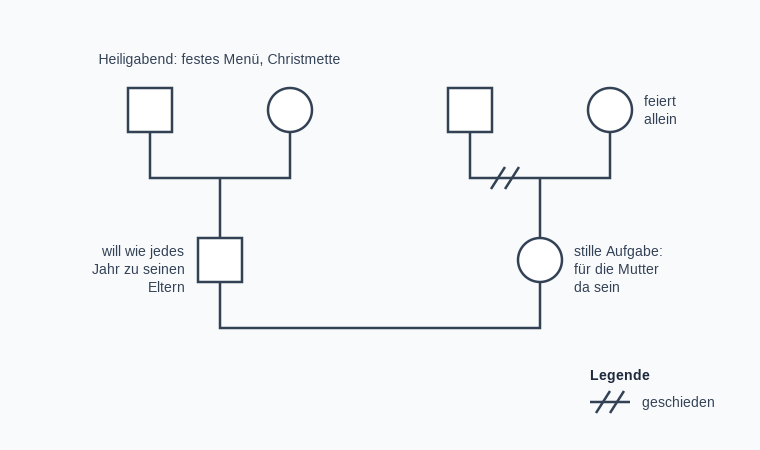
What the Genogram of Both Families Does
It makes unspoken obligations visible. Someone who travels to the in-laws is often fulfilling an assignment they cannot name themselves. In the genogram, it becomes a line, a role, a history.
It puts both sides on the same surface. In a fight, one’s own family easily appears “normal” and the other “difficult.” Two genograms side by side show: Both families have their own logic. Neither is the yardstick.
It shifts the question from who to what. Instead of “Who gets their way?”, the question becomes which obligations are on the table. Then it is also possible to negotiate which ones the couple wants to fulfill consciously and which ones they want to change.
It relieves the couple relationship. Someone who sees that the other side is not acting against them but for their own family can respond differently. This takes the edge off the conflict without playing it down.
Questions That Help in Counseling
The following questions have proven useful when both genograms are in front of the couple:
- How did your family celebrate, and who decided that?
- Who would be disappointed if you didn’t come? And who would never say so?
- Are there celebrations where someone is missing and isn’t talked about?
- Which tradition do you want to keep? Which would you like to pass on?
- What would be a first small step that both families could bear?
Blended families and separation also show up in the genogram immediately. When children commute between separated parents, the negotiation becomes even denser. In its Christmas tips for separated parents, the Children and Youth Advocacy Office of Upper Austria (Kinder- und Jugendanwaltschaft Oberösterreich) points out that the risk of a loyalty conflict for children is especially high because of the emotional significance of the holiday. It advises agreeing early on who celebrates with the child when, and not leaving the decision to the child (KiJA OÖ, 2019). For couples counseling, this means: The children, too, belong in the picture with their routes and obligations.
Negotiating Instead of Winning
Working with the genogram often leads to solutions that were previously unthinkable. One of them is alternating every year. It can also mean that Christmas Eve is shared, that another day becomes one family’s “holiday,” or that one family deliberately gets the first day of Christmas. Some couples decide to start a ritual of their own as a two.
What matters: It is not the solution that heals, but the conversation about it. When both feel that their obligations are seen, saying no to one family becomes easier. It is then no longer experienced as betrayal.
Homework for the Holidays: Filling Gaps in the Genogram
Family gatherings are also an opportunity. Many gaps in the genogram can only be closed where the older generation tells their stories. Clients can take this on as a small, voluntary task.
- Prepare one question, not ten. For example: “How did you celebrate Christmas back then?” or “What was Grandpa’s brother actually called?”
- Choose the right moment. Over coffee, on a walk, or while leafing through the photo album rather than in the middle of the commotion.
- Listen, don’t complete. The person telling the story should not be corrected. Unclear details may stay unclear.
- Accept a no. Some topics are hard for the older generation. Someone who withdraws is also giving information: “Something here still hurts.”
- Force nothing. It is perfectly fine to take a question home unasked.
- Write it down later. Make a short list of keywords after the holiday, while the memory is fresh. It can be transferred into the genogram in the next session.
As a professional, you can ask in advance: “Which person might know something, and what would be a respectful occasion to ask?” That way, the homework does not turn into an interrogation.
Limits and Care
Not every couple should visit the parents, and not every family can bear questions. In cases of violence, abuse, or severe strain, the protection of clients comes before any genogram task. Then the “homework” can also be: allowing oneself not to go.
This also includes the question of confidentiality. What relatives tell belongs to them. Clients should not use it against them. And a genogram that contains names and family histories belongs in a protected place.
Conclusion
Holidays show how many families live along in a partnership. The genogram places these families next to each other rather than against each other. It turns “You favor your parents” into “We carry two obligations and are looking for a way.”
Sources
- Bryant, C. M., Conger, R. D., & Meehan, J. M. (2001). The Influence of In-Laws on Change in Marital Success. Journal of Marriage and Family, 63(3), 614–626. https://doi.org/10.1111/j.1741-3737.2001.00614.x
- Kinder- und Jugendanwaltschaft Oberösterreich / Amt der Oö. Landesregierung (2019). Tipps der Kinder- und Jugendanwaltschaft OÖ: Weihnachtsfrieden statt Kontaktrechtsstreit für Kinder getrennt lebender Eltern. Press release of December 6, 2019, Landeskorrespondenz Nr. 237. https://www.land-oberoesterreich.gv.at/228340.htm