Module 2 “Applying” — Lesson 40 · Reading time approx. 9 min
Sometimes grandparents, parents and children sit in the room together. This lesson shows how to create a three-generation genogram with everyone present, stay multipartial and relieve the middle generation.
When the Older Generation Comes Along
Some families do not come as a pair or a trio. The grandmother brings the grandchild to the appointment. The grandfather sits beside her and looks at the clock. The mother says little, because she knows he will answer right away.
Such constellations are more common than textbook images suggest. Grandparents look after grandchildren in everyday life. They are foster family or guardian. Or they lead the family, because they have the house, the money or the experience.
This lesson shows how to work in this situation.
The reverse case is in the magazine: When the Client Knows Nothing About the Grandparents. Here the grandparents are present and speak for themselves.
What Is Practical Knowledge in This Lesson
This lesson describes a way of working from systemic counseling, not a study.
Test every suggestion against your own family and with your supervision.
Three Constellations, Three Questions
Not every family with grandparents in the room is the same. Three constellations are common.
Grandparents as caregivers. They pick up, cook, accompany to appointments. The parents work or are under strain. Here the question is: Who makes which decision?
Grandparents as foster family. The grandchildren live with them because the parents cannot manage. The parents may be present, or may not. Here the question is: Who is what to whom, and how does that feel for each person?
Grandparents who set the rules. The adult children live nearby and follow the line of the older generation. Here the question is: Where is the middle generation independent, and where not?
In all three cases, at least three generations sit in the room. The middle generation stands between two sides. It is child to one and parent to the other.
A Genogram Everyone Can See
Draw the genogram so that everyone can see it. A large screen or a flipchart works well. Then no one works “behind the backs” of the others.
Begin with the grandparents. This is a sign of respect. It also makes professional sense, because the family then takes shape from top to bottom.
Here is how to proceed:
- Start with an open question. “Who belongs to your family, and who is here today?”
- Ask the older ones first. “How did the family begin?” This gives them space without letting them take over the session.
- Name the order. “I will ask the grandparents first, then the parents, then the children. Every voice counts.”
- Note both versions when they differ. If grandmother and mother tell the same story differently, write down both versions. You do not decide who is right.
- Involve the children early. Let them choose a symbol or decide on the color. That way they are participants and not spectators.
The symbols stay the familiar ones. You do not need new signs. Enter additional information as a note, for example “looks after on Mondays and Wednesdays” or “guardian since 2022”.
What the Grandparents Have Experienced
Grandparents have their own history. They have experienced war, flight, poverty, early loss or shame. Or they raised their children alone and never spoke about it.
This continues to have an effect. A grandmother who had to go hungry as a child insists that the plate be emptied. A grandfather who had to work early has little patience with hesitation. Such patterns are not “wrong”. They are answers to what the person experienced.
The genogram makes these stories discussable. Once they are on the page, they are no longer just a tone at the kitchen table. They gain a place and a time.
Helpful questions for the grandparents:
- “What was it like at home when you were a child?”
- “What did you take from your parents that you wanted to pass on?”
- “What did you want to do differently with your children?”
Watch the pace. Not every memory has to be laid out in front of the family. The offer is enough. Whoever deflects may deflect.
How such burdens move across generations is described in the lesson Loyalties and Invisible Bonds. It helps to place the roles in the room.
Roles and Loyalties Across Three Generations
In three-generation families, loyalties cross. The grandchildren are bound to their parents and often to their grandparents as well. The parents are obligated to their own parents and to their children. The grandparents are bound to their children and to their grandchildren.
This can sustain. It can also burden. When someone speaks for one side, another feels betrayed.
In the genogram you see signs of this tension:
- A close line between a grandparent and a grandchild, while the line to the parent is thin.
- A parent who has hardly any space next to their own parents. The person speaks little and looks to the side.
- Tasks that move from top to bottom or the other way round. Who raises the child, who decides, who pays?
- Recurring patterns. The grandmother already cared for her mother. Now the daughter cares for the grandmother.
These signs are a reason to ask questions, not proof. When children take on an adult role, look at the lesson The Child Who Is a Parent.
Staying Multipartial
Multipartiality means: you stand by everyone. You are not neutral and not distant, but turned toward each person. With grandparents in the room this is hard, because an alliance easily forms.
The danger shows in two places. First, one tends to attribute authority to the older ones. Then the mother no longer speaks. Second, one may want to protect the mother. Then the grandparents fall silent.
These attitudes help:
- Each person gets about the same amount of time. This seems trivial, but it is the most important lever.
- Acknowledge every contribution. “Without your care, this would not work.” And: “You hold your daily life together in a difficult time.” Both can stand.
- Summarize instead of evaluating. “I hear: You are worried because … And you, because …”
- Look for the worry behind the reproach. Behind “You are too lenient” there is often “I am afraid for the child”.
- Check your own reactions. If you are annoyed with someone, note it for supervision. It says something about your own family history.
Relieving the Middle Generation
The middle generation often carries the load from two sides. It is expected to do justice to its parents and to its children. On top of that, it has wishes of its own.
Questions that acknowledge its situation are relieving:
- “What is it like to deal with your own parents and your own children at the same time?”
- “What in the family would you like to leave as it is? What would you like to do differently?”
- “What would help you if something were allowed to change?”
- “How do you notice that you are a parent and not the child of your parents?”
The last question needs tact. Ask it only if the relationship is already solid.
A simple gesture is also relieving. Address the middle generation by name and not only as “the mother” or “the father”. This gives back a piece of independence.
An Example Across Three Generations
Hypothetical case example: A grandmother and a grandfather come to counseling with their granddaughter, twelve years old, and her mother. The granddaughter spends her afternoons with the grandparents because the mother works shifts. The parents are separated, the father lives far away. The grandfather begins right away: things are not going well at school, and at home there are too few rules. The mother looks at the floor. The counselor draws the genogram so that everyone can see it and begins with the grandparents. She asks: “What was it like for you when your daughter was twelve?” The grandfather says that he often worked night shifts back then and his wife carried everything alone. The grandmother nods. The counselor enters the note “shift work” next to the grandfather. She puts the same note next to the mother, who works shifts herself today. Then she asks the mother: “What would you like to leave as it is in your daily life?” The mother raises her eyes and says: “That the little one is with me in the evening.”
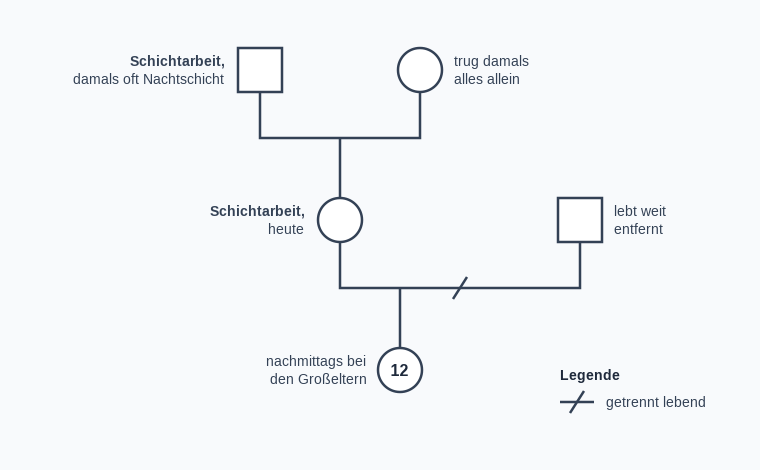
The counselor uses the grandparents’ story. This gives the reproach a background, and she acknowledges the older generation without overlooking the mother. The last question gives the middle generation space for its own wishes for the first time.
When a One-on-One Conversation Is Better
The joint conversation has limits. In these cases a one-on-one conversation is the better choice.
- In cases of violence or fear. If someone in the room does not feel safe, speak separately. If there are signs of endangerment, child protection rules and those of your organization apply.
- With a strong power imbalance. If one person constantly interrupts the others, a separate conversation with each side helps.
- With secrets. Some topics a person can only voice without the others. Clarify beforehand what will be passed on.
- In conflicts over custody and contact. Where legal questions are involved, such as guardianship or foster care arrangements, a clear separation of roles is important.
- When a child wants to say something alone. Offer the child a separate appointment.
Say at the start how you work: “Today we are talking together. If someone would rather discuss something alone, that is possible at any time.” This sentence takes the edge off a later switch.
Data protection and confidentiality also apply in a room with several people. Clarify who may see which information before you save or print the genogram.
For Practice
- Draw the genogram so that everyone can see it and begin with the grandparents.
- Note different versions of the same story side by side.
- The grandparents’ history continues to work in the family. The genogram makes it discussable without evaluating it.
- Watch for loyalties between three generations and for roles that move.
- Multipartiality means: equal speaking time, acknowledging contributions, looking for the worry behind reproaches.
- Relieve the middle generation with questions about its own wishes.
- In cases of violence, strong power imbalance or secrets, one-on-one conversations are better.
Sources
This lesson cites no study. The linked lessons serve for further reading.